

 1

What the six-hour attribution window measures
Atomato credits campaign revenue to clicks, not views. You'll see what the six-hour window counts, what it leaves out and how to read your results.

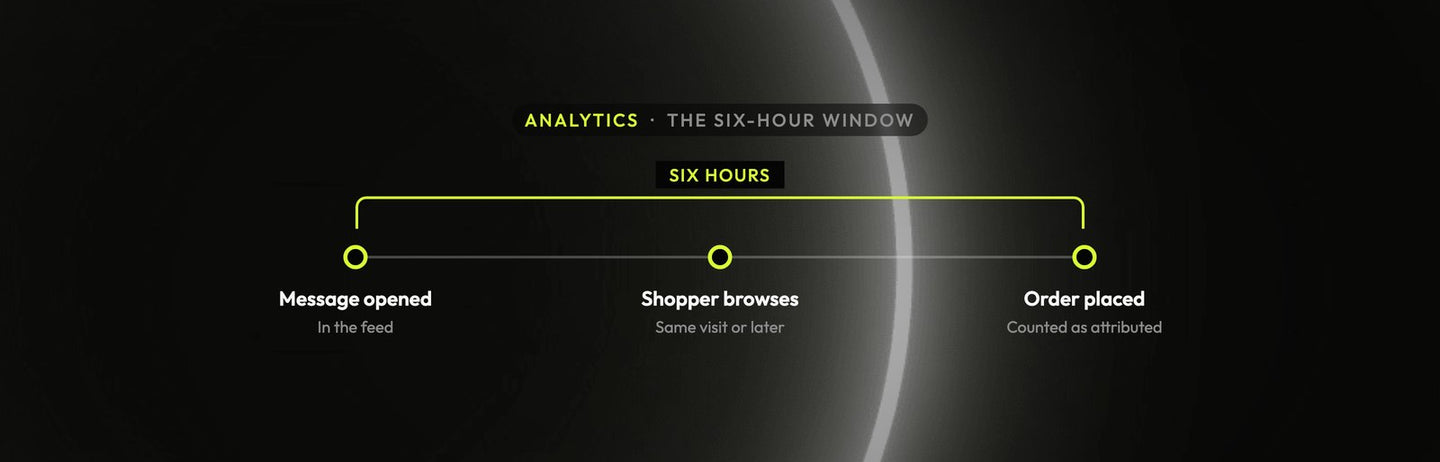
Atomato credits campaign revenue from clicks, not views: it counts products added to cart within six hours of a click through to a product, collection or search page, or within three hours of a click through to another store page. If you remember only one thing from this guide, make it this: an impression is not a conversion, and an attributed order is not the same as proven incremental revenue.
This post covers what the window includes and what it leaves out, then gives a short guide to reading a week of campaign results without over-claiming. For the broader measurement process, see how to measure the revenue generated by your campaigns. Related feature: Analytics.
What the number is
When Atomato reports revenue for a campaign, it links a click on that campaign (message or product card) to the products the shopper added to cart within 6 hours (3 hours when the click opened a store page other than a product, collection or search page) and then bought in the same browser within 30 days. It is a time-boxed link between an interaction and an order: useful for comparing campaigns, but no guarantee that the message alone caused the order.
Click vs view vs attributed order
Use this list when you review a report. For each signal, the first part says what it means and the last part gives the honest limit.
- View or impression: the message was shown. It doesn't mean the shopper was interested, clicked or will buy.
- Click: the shopper interacted with the message or product card. It doesn't mean that click alone produced the order.
- Attributed order: an order in the same browser included products added to cart after a click. The add to cart window is 6 hours, or 3 hours for clicks to other store pages. It doesn't mean proven incremental lift over showing no message.
A worked example (illustrative numbers)
Consider a free-shipping progress card with 400 views, 40 clicks and 6 orders worth a total of $720 in attributed revenue over the period.
- The click-through rate is 10% (40/400), which suggests shoppers noticed the message.
- Attributed revenue per click is $18, a useful figure for comparing this campaign with another.
- You still do not know how many of those six orders would have happened without the card. Treat the $720 as attributed revenue, not proven incremental revenue.
If another campaign has more views but far fewer clicks, it would be wrong to crown the high-view campaign the winner.
What falls outside the window
Products added to cart after the window closes do not get credit for that click, and neither do orders placed in another browser or more than 30 days after the click. Cross-device journeys, later email/SMS touches from your ESP, and unpaid organic return visits can still close the sale without showing up on that Atomato campaign row. Rely on your ESP's reporting for the later channel and on Atomato for the on-site click window.
How to review a week without over-claiming
- First, sort campaigns by clicks and by attributed sales.
- Look at the low-click campaigns and fix relevance or audience issues before you rewrite the copy.
- When you report to stakeholders, share checkout and ESP data alongside the on-site numbers.
- Say "attributed after a click," not "Atomato made $X."
Audience rules decide whether the right people get the message at all. See how to decide who sees a campaign.
| Feed message | Links to | Impressions | Clicks | Revenue / 1k |
|---|---|---|---|---|
| Free shipping over $50 | Sale Collection | -- | ||
| Back in stock: Canvas Tote | Canvas Tote Product | -- |
Why six hours (our reasoning)
A short window keeps the credit close to what actually happened on the site. Longer windows also sweep in more of the channels that act later (email, SMS, return visits), which makes the campaign look stronger than the click deserves. Atomato's short click windows are a deliberate choice: they make it less likely that your ESP's results get counted as Atomato's. You can still check the revenue your ESP reports for the later send, but do not double-count it as if it were additional incremental lift.
Next step
Open Analytics on a live campaign and check clicks before you debate revenue. To install, see Atomato on the App Store.


Keep reading
Read next
-
-
Grow your store
A guide to announcing your loyalty program on your Shopify store
-



Ready to show the right message to the right shopper?
Start showing targeted on-site messages without changing your marketing setup. Atomato works alongside the popup, email and SMS tools you already use.
Five-minute setup. No theme code or developer needed.